Get In Touch
Tell us what you need and we’ll come back to you with advice, suitable bollard options and the next steps for getting your installation booked.
Yes, driveway bollards can be well worth installing if you want to make vehicle theft more difficult, prevent unwanted parking or control access to your property. Unlike cameras and alarms, a bollard creates a physical barrier between a parked vehicle and the road.
How useful one will be depends on your driveway, the vehicle you are protecting and the type of bollard you choose. A well-positioned bollard that is easy enough to use every day can provide a valuable additional layer of security. One that is inconvenient and regularly left lowered will naturally offer much less protection.
For most homeowners, the question is therefore not simply whether driveway bollards work, but which type is best suited to the property and how it will be used.
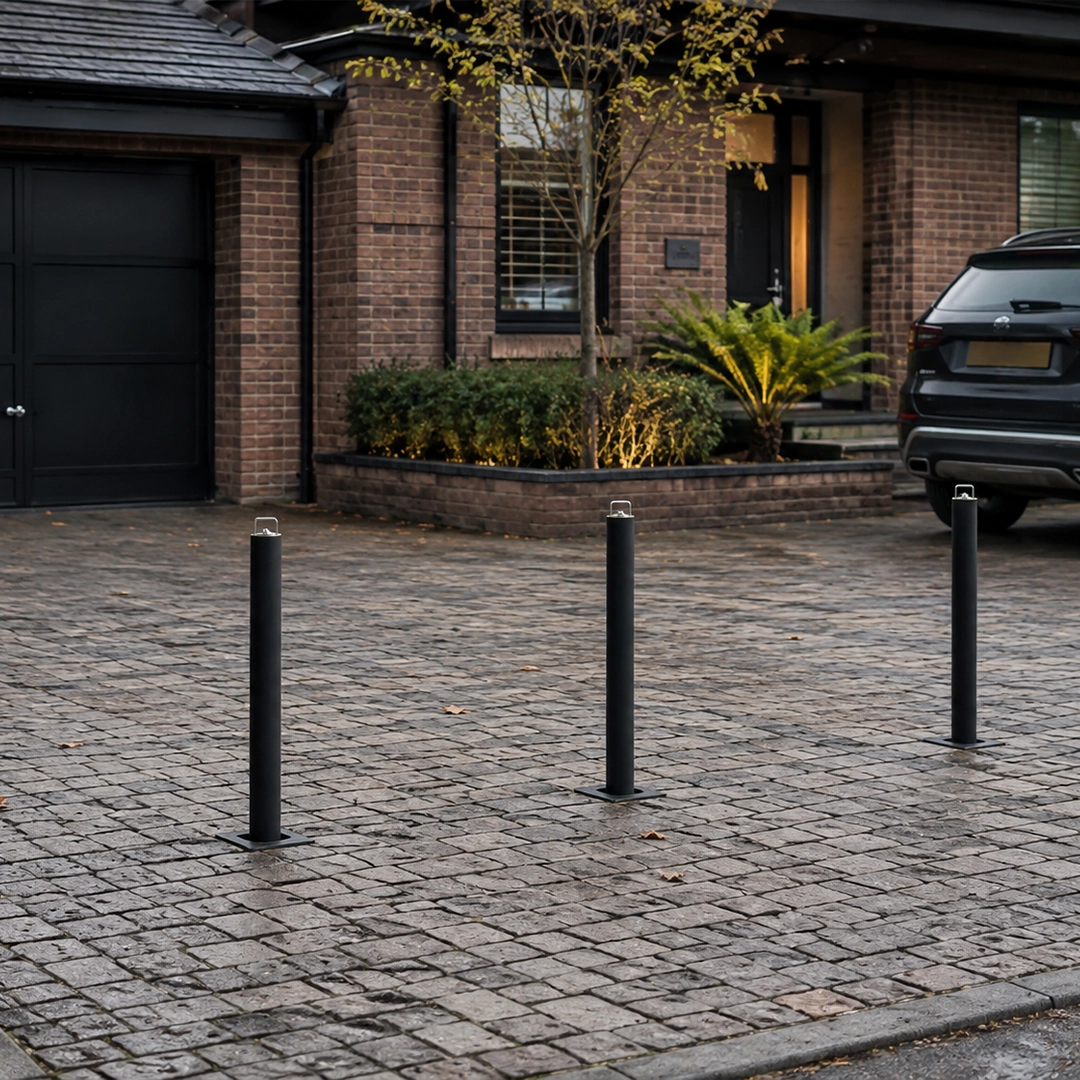
A driveway security bollard is a strong post positioned at the entrance to a driveway or in front of a parked vehicle to restrict vehicle movement.
Depending on the design, the bollard may retract into the ground, fold down or be removed when access is required. Once raised and locked, it creates a physical obstacle that prevents a vehicle from simply being driven straight off the property.
This makes bollards different from many other forms of home security. CCTV, alarms and lighting can help detect or deter suspicious activity, whereas a bollard physically blocks the vehicle’s route.
The main benefit of a driveway bollard is straightforward: it puts another obstacle between your vehicle and the road.
A correctly positioned bollard can:
No security product can guarantee that a vehicle will never be stolen. The purpose of a bollard is to increase the time, effort and difficulty involved in moving the vehicle without permission.
A driveway bollard can be particularly useful where a vehicle is parked on an open driveway with a clear route onto the road.
Without a physical barrier, somebody who gains access to the vehicle may be able to drive it away immediately. A raised and locked bollard changes that. Before the vehicle can leave, the obstacle itself has to be dealt with.
This does not only apply to prestige, performance or high-value cars. Losing any vehicle can cause considerable disruption, particularly if it is relied upon for work, family transport or everyday travel.
Bollards are most effective as part of a layered approach to vehicle security. Other sensible precautions include:
It can also be sensible to keep the bollard key separately from the vehicle keys rather than carrying both together.
Yes. Bollards are not only used for vehicle theft prevention. They can also provide a simple way to control who is able to use a driveway or private parking space.
When the post is raised and locked, another vehicle cannot simply drive into the space in the normal way. The bollard also makes it visually obvious that the space is private and access is controlled.
This can be particularly useful for:
If the proposed installation is within a shared driveway or communal area, ownership and access rights should be checked first. A bollard should not interfere with another person’s legitimate access or obstruct a public highway.
There are several ways to create a physical barrier across a driveway. The best choice usually depends on how frequently the driveway is used, how much security is required and how convenient the bollard needs to be.
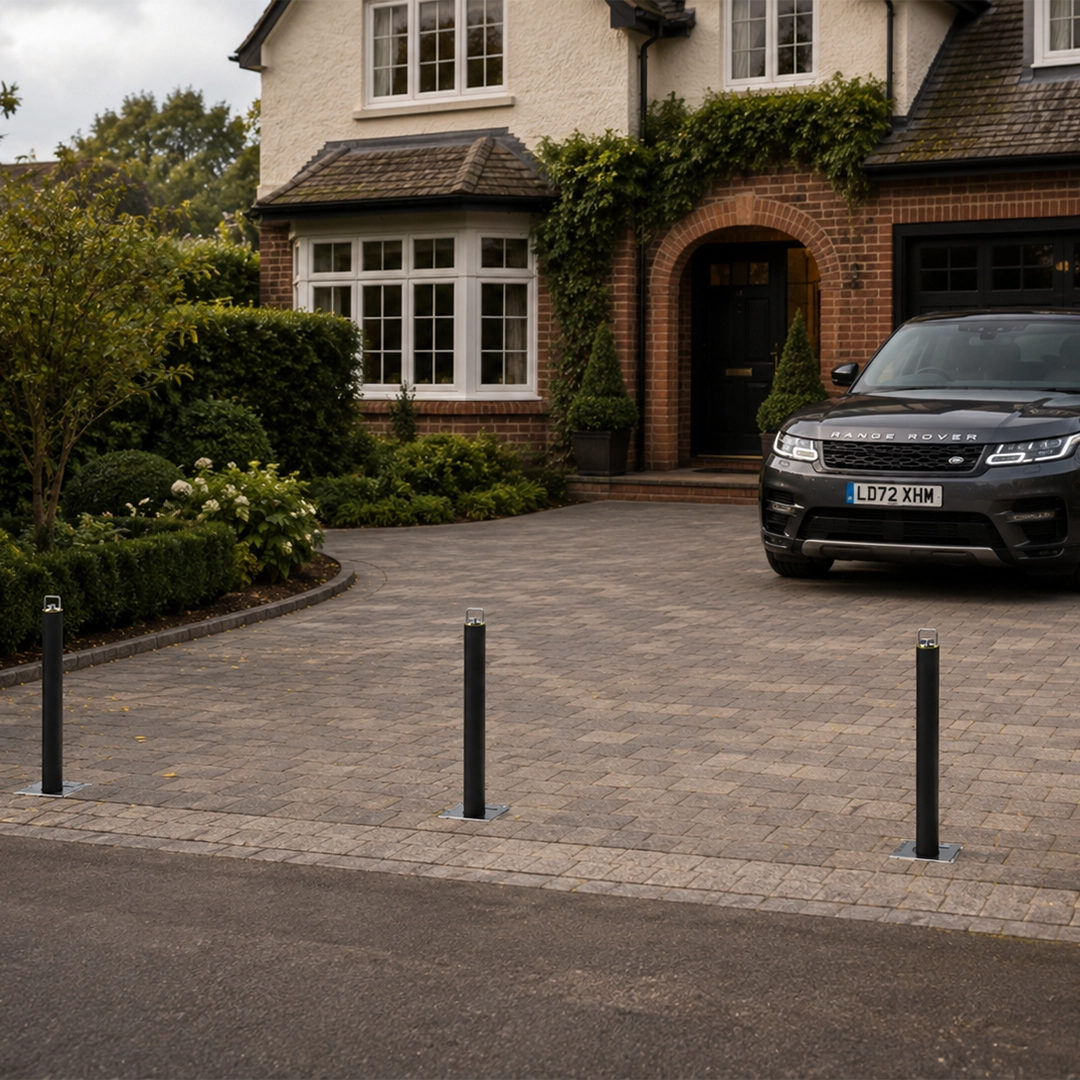
Telescopic bollards retract vertically into a housing installed beneath the driveway.
When security is required, the post is pulled up and locked into position. When the driveway needs to be opened, it is unlocked and lowered back into the ground.
This makes telescopic models particularly convenient for residential driveways because there is no separate post to carry away or store. Once lowered, the driveway is largely clear.
The below-ground housing means installation and drainage need to be considered carefully, but for a driveway that is opened and closed regularly, a telescopic post can offer an effective balance between security and everyday convenience.
Northern Bollards offers a range of telescopic security bollards for domestic and heavier-duty applications.
Removable bollards lock into a socket installed within the driveway. When access is needed, the entire post can be unlocked and lifted out.
The advantage is that the entrance can be completely clear once the bollard has been removed. This can work well where access is only required occasionally.
The main consideration is convenience. Somebody has to lift and store the bollard each time it is removed, so the weight of the post and the available storage space should be taken into account.
A fold-down bollard remains attached to the driveway and pivots towards the ground when access is required.
They can provide a relatively simple way to secure a driveway or parking space without requiring a post to be removed completely. However, the bollard remains on the surface when lowered, so vehicle clearance and pedestrian access need to be considered.
For many frequently used residential driveways, they can be.
The installation is generally more involved because a housing needs to be fitted below ground. However, the advantage is that the bollard retracts into the driveway rather than needing to be carried elsewhere.
If you leave and return several times during an ordinary week, that convenience can become important. A security measure that is straightforward to operate is far more likely to be used consistently.
This is one reason the cheapest option is not automatically the best value. Ease of use matters just as much as the initial purchase price.
There is no fixed number. A narrow driveway may only need one correctly positioned bollard, whereas a wider entrance may require two or more.
The important point is whether a vehicle can physically manoeuvre around the posts.
When deciding how many bollards are needed, consider:
A single post positioned centrally may be effective on a relatively narrow entrance. On a wide driveway, the same arrangement could leave enough room for a vehicle to drive around either side.
Correct positioning is therefore just as important as the strength of the bollard itself.
In most cases, the bollard needs to sit between the parked vehicle and the driveway entrance while still leaving enough room for everyday access around the car.
Position it too close to the vehicle and loading, unloading or walking around the car may become awkward. Install it too far towards the road or too close to one side and there may be enough room for a vehicle to manoeuvre around it.
The driveway layout should be looked at as a whole rather than choosing a position based purely on appearance.
Professional installation also allows the proposed location to be considered alongside the existing surface and any obvious drainage or access issues.

The cost of a driveway bollard depends on the product, the materials used, the number of posts required and the installation involved.
A heavier-duty security bollard will naturally cost more than a basic parking post. Likewise, a telescopic bollard requiring excavation and a below-ground housing involves different work from a surface-mounted system.
The driveway itself can influence the installation too. Block paving, concrete, tarmac and gravel each require different preparation and reinstatement.
When comparing prices, it is better to consider the complete installed solution rather than looking only at the price of the bollard.
Useful questions to ask include:
You can view current options on the Northern Bollards driveway security bollards page.
They can be, provided the correct type is chosen.
Manual security bollards require somebody to operate them whenever the driveway is opened or secured. How inconvenient that feels will depend heavily on the mechanism.
For example, somebody using a removable post must lift it out and store it somewhere. A telescopic bollard stays within the driveway and simply lowers below the surface.
Think about how the driveway is actually used rather than how you expect to use it occasionally.
If several family members leave at different times every day, convenience will matter more than it might for a vehicle that only leaves the driveway once or twice each week.
This is another practical point that is easy to overlook.
Consider every person who may need to secure or open the driveway. The weight of the bollard, the amount of bending required and the location of the lock can all affect how straightforward it is to use.
This may be particularly important for older users or anybody with reduced mobility.
A very substantial bollard is of little practical value if members of the household find it too difficult to operate and regularly leave it lowered.
Most manual driveway bollards need relatively straightforward care, but they should not simply be installed and forgotten.
Locks and moving components should be kept reasonably clean and used in accordance with the manufacturer’s instructions.
For telescopic bollards, dirt and debris can collect around the below-ground housing. Leaves, grit, mud and ice should not be allowed to build up around moving components.
It is also worth occasionally checking the driveway immediately around the bollard. Loose paving, damaged concrete or movement around the installation point could affect how the post operates.
If the bollard begins to feel unusually difficult to operate, it is better to investigate the cause rather than forcing the mechanism.
A bollard is not automatically suitable for every property or every part of a driveway.
Potential limitations include:
These issues do not always mean security bollards are impossible. They may simply mean a different type, quantity or installation position needs to be considered.
They serve different purposes, so one does not necessarily replace the other.
CCTV is primarily a monitoring and recording measure. A bollard is a physical access-control measure.
If somebody approaches your vehicle, a camera may record what happens. A locked bollard physically restricts the route between the vehicle and the road.
For that reason, the strongest approach is often to use different types of security together rather than expecting one product to provide complete protection.
A bollard does not prevent somebody from attempting to exploit a keyless-entry system. What it can do is create a separate physical obstacle even if access to the vehicle itself has been gained.
This distinction is important. Electronic vehicle security and physical driveway security address different stages of a potential theft.
Using suitable key storage alongside a properly secured driveway bollard can therefore provide two different forms of protection rather than relying on either measure alone.
Start with the property and the way the driveway is used rather than simply choosing whichever bollard looks strongest.
Important considerations include:
For a domestic driveway that is used every day, ease of operation can be every bit as important as the specification of the bollard.
They are particularly worthwhile where there is a clear problem to solve.
Examples include a valuable vehicle parked on an open driveway, repeated unauthorised parking, a private parking space that needs to be controlled or a driveway where an additional visible security measure would provide reassurance.
On the other hand, installing a bollard simply because it is the strongest product available does not necessarily provide good value. The bollard needs to suit the driveway and be practical enough to use consistently.
A correctly positioned and locked driveway bollard creates a physical obstacle that prevents a vehicle from being driven directly off the property. It should be used alongside other sensible security measures rather than relied upon on its own.
It can be. One bollard may adequately protect a narrow driveway, but wider entrances often need two or more posts to prevent a vehicle from manoeuvring around them.
Telescopic bollards are a popular option for regularly used driveways because they lower into the ground when access is required. The best choice still depends on the driveway width, surface, vehicle and user’s requirements.
In many cases, yes. The paving around the installation point will normally need to be lifted and reinstated as part of the work. The exact installation method depends on the bollard and the construction beneath the paving.
No security measure can guarantee that a vehicle will not be stolen. A bollard adds a physical barrier that can make removing the vehicle more difficult and time-consuming.
Potentially, but ownership and access rights need to be clear first. A bollard should not prevent another person from exercising a legitimate right of access.
They are designed to retract into the ground when access is needed, removing the need to carry and store a separate post. Their suitability depends on the individual product and the person operating it.
For many homeowners, yes. A driveway bollard provides a visible physical barrier that can make vehicle theft more difficult, prevent unwanted parking and give you greater control over access to your property.
The biggest benefit is that it performs a different job from cameras, alarms and electronic vehicle security. Rather than simply detecting activity, it physically restricts vehicle movement.
The best results come from choosing a bollard that suits the width and surface of the driveway, positioning it correctly and selecting a mechanism that is convenient enough to use every day.
If you are unsure how many bollards you need or which type would suit your property, contact Northern Bollards for advice on the available options and installation.
Tell us what you need and we’ll come back to you with advice, suitable bollard options and the next steps for getting your installation booked.
Read Another Post…