Get In Touch
Tell us what you need and we’ll come back to you with advice, suitable bollard options and the next steps for getting your installation booked.
In many cases, a low, manually operated driveway bollard installed entirely within private property will not need planning permission. However, there is no single rule that applies to every driveway, every property or every type of security barrier.
The position and height of the bollard, whether the property is listed, whether access is shared and whether the work affects a pavement or public highway can all change what permissions or checks are required.
This guide looks at the main points homeowners in England should consider before installing driveway bollards or other access barriers. Different planning and highway rules can apply in Scotland, Wales and Northern Ireland.
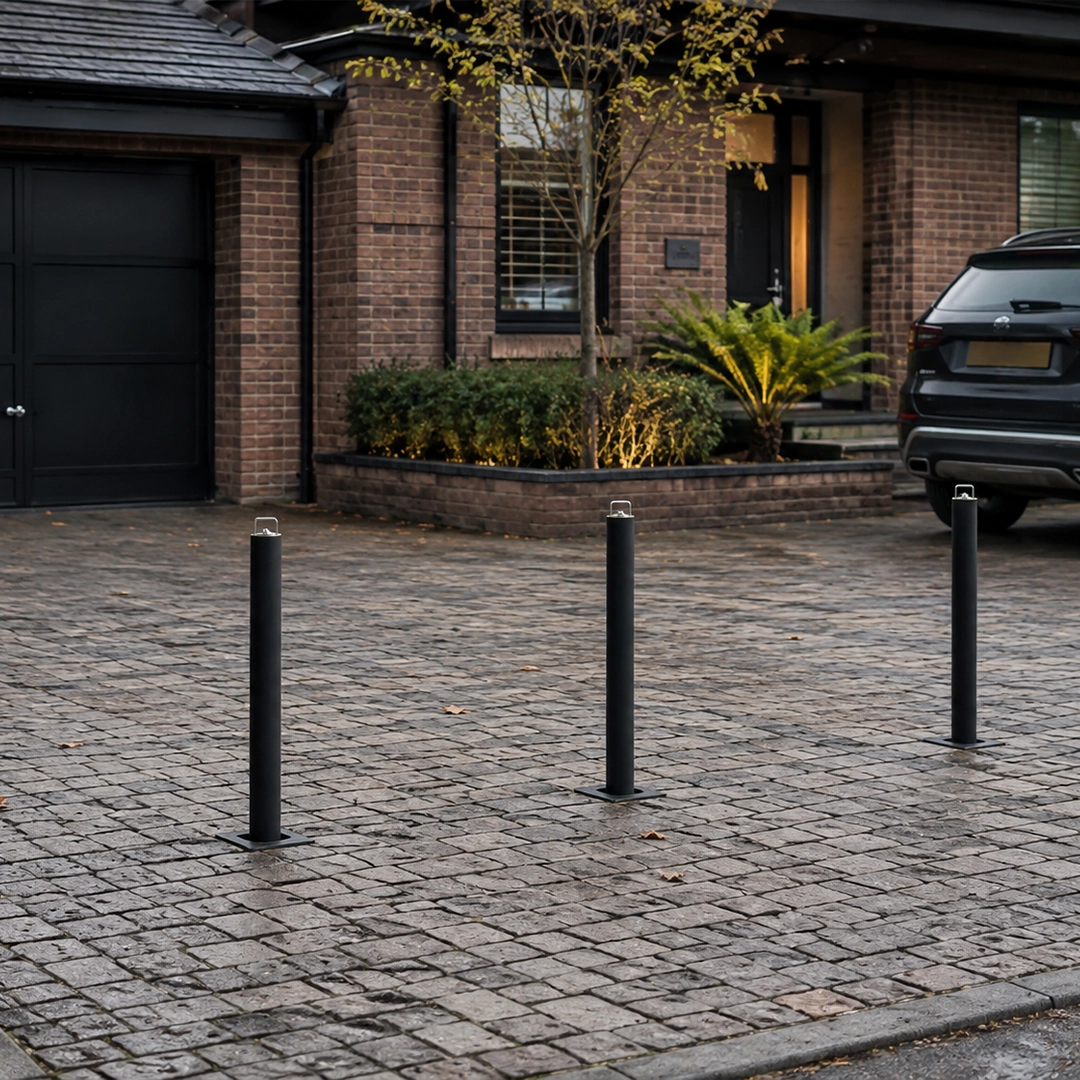
Many ordinary residential driveway bollards can be installed without a planning application, particularly when they are relatively low, manually operated and positioned entirely within the property boundary.
That does not mean every installation is automatically permitted. A local planning authority may take an interest where the bollards effectively form a new boundary, are unusually prominent or are installed as part of wider changes to the entrance of the property.
Planning permission may be more likely to be needed where:
If there is any uncertainty, it is sensible to check with the local planning authority before ordering the bollards or beginning excavation.
The term can cover considerably more than a simple security post. Common driveway and access barriers include:
These are not necessarily treated in the same way for planning purposes. A small manual post installed well inside a private driveway is very different from a large powered gate positioned immediately beside a public pavement.
The height, position, method of operation and effect on neighbouring or public access all need to be considered.
In England, planning rules generally allow a new wall, fence or gate without a planning application where it is no more than one metre high when positioned next to a highway used by vehicles, including the pavement alongside it.
Elsewhere, the usual permitted height is up to two metres.
A planning application will normally be needed where a new wall, fence or gate exceeds the relevant height limit.
These limits do not necessarily give a complete answer for an individual driveway bollard. Its purpose, location and whether it forms part of a wider boundary arrangement may also be relevant.
A driveway bollard should remain within the property boundary and should not obstruct the public highway.
The public highway can include more than the road itself. Pavements, verges and other areas over which the public has a right to pass may also form part of it.
A post, gate, socket or foundation should not project into the pavement or make it more difficult for pedestrians, wheelchair users or people with pushchairs to pass safely.
The same principle applies to gates. A gate positioned next to the street should not swing out across the pavement or road when it is opened.
A bollard does not create a right to drive over a normal raised kerb or pavement.
Vehicles should normally access a driveway using an authorised dropped kerb or vehicle crossover. If a new vehicle entrance is being created, or an existing crossover is being altered, the local highway authority may need to approve the work.
Requirements can vary depending on the location, but councils may consider matters such as:
A new dropped kerb can also involve planning requirements in some circumstances, so a new driveway entrance should be considered separately from the bollard itself.
Any changes around the entrance to a property should allow drivers to see pedestrians, cyclists and approaching traffic clearly.
A typical low driveway bollard may have little effect on visibility, but taller gates, walls, fencing and landscaping around the same entrance can be more significant.
Where the property opens onto a busy road, visibility may be considered when a new entrance or boundary feature is proposed.
Some driveway layouts may also require enough space for a vehicle to wait within the property while a gate or barrier is opened rather than stopping across the pavement.
You should not install a locked barrier across shared access without first establishing who owns the land and who has a legal right to use it.
A driveway can be privately owned while still being subject to rights allowing neighbours or other parties to pass over it. Blocking that access could lead to a dispute even if the bollard itself sits on land belonging to the person who installed it.
Before installing bollards on a shared or communal entrance, it may be necessary to check:
Where several authorised users need access, choosing locks that can be keyed alike may make everyday use easier. It does not, however, replace the need to establish whether the barrier can legally be installed in the first place.
Private land can sometimes contain a public right of way.
A lane, track or driveway may therefore be privately owned while members of the public still have a legal right to use a particular route through it.
A locked bollard or gate should not be placed across a public right of way without any approval that is required. An unauthorised obstruction could ultimately have to be removed.
If the status of an access route is unclear, the local authority may be able to confirm whether a recorded public right of way passes through or alongside the property.
Additional checks are sensible where a home is listed or sits within the grounds of a listed building.
Controls relating to listed buildings are concerned with protecting architectural and historic character. Changes to entrances, boundaries and surrounding land may therefore need more consideration than they would at an ordinary property.
Even where a bollard is not attached to the building itself, excavation or a new modern feature within a sensitive setting may still be relevant.
Owners of listed properties should check with the appropriate planning or conservation team before work begins.
Living in a conservation area does not automatically mean that a driveway bollard cannot be installed, but additional restrictions can apply.
Changes to existing gates, fences, walls or other boundary features can be subject to greater control. Local design policies may also influence the appearance, material, height or colour of replacement features.
If installing bollards involves wider alterations to the frontage of a property within a conservation area, it is worth checking the position before committing to the work.
Permitted development rights allow certain types of work to be undertaken without making a full planning application.
These rights are not identical for every property. They can be restricted or removed in some circumstances.
An Article 4 direction, for example, can restrict certain permitted development rights within a defined area. Planning conditions attached to earlier development of the property can also affect what can subsequently be added.
This can occasionally be relevant on newer housing estates or developments deliberately designed with open front gardens and few boundary structures.
The fact that neighbouring properties do not have gates or bollards does not by itself prove that they are prohibited, but it may be a useful reason to check the planning history.
Ordinary driveway barriers such as manual bollards do not generally require building regulation approval in the same way as construction work to a house.
That does not remove the need for the installation itself to be safe, stable and suitable for the surface.
Different driveway security bollards can require very different groundwork. A below-ground telescopic post needs excavation and a suitable housing, whereas other products may rely on different foundations or fixings.
Poor installation can leave a bollard unstable, difficult to operate or badly positioned in relation to vehicles and pedestrians.

Powered gates and automatic barriers raise additional safety considerations because the equipment moves under power.
Potential risks can include crushing, trapping, impact and shearing around moving parts.
A professionally installed powered system may need safety measures such as:
Northern Bollards primarily deals with manually operated security bollards rather than powered gate systems. Anyone considering an automated gate or powered rising barrier should use a competent specialist familiar with that type of equipment.
Yes, particularly with a telescopic bollard.
A telescopic post retracts into a housing beneath ground level, so water and debris need to be managed properly around the mechanism. Poor drainage can interfere with the operation of a below-ground system over time.
You can see how these products differ on the Northern Bollards telescopic bollards page.
Separate planning considerations relating to surface water can also become relevant where installation forms part of a much larger front garden or driveway resurfacing project.

Yes. Any bollard requiring below-ground excavation needs to be positioned with underground services in mind.
Possible services beneath or alongside a driveway include:
Plans can help identify known services, but their exact route and depth should not simply be assumed. Appropriate checks and safe excavation methods are important before digging begins.
A tenant should obtain permission from the property owner before drilling into or excavating a driveway to install a permanent security feature.
Leaseholders may also need approval from a freeholder or management company, even where the parking space is allocated exclusively to them.
Landowner consent and planning permission are two separate issues. Planning approval does not give somebody the right to carry out permanent work on land they do not own.
Before booking a bollard installation, it is worth working through a few basic checks:
Many ordinary manual bollards installed entirely within a private residential driveway will not require planning permission. The position, height, property type and any existing planning restrictions can affect the position, so individual circumstances should still be checked where there is doubt.
Potentially, provided it remains within your property boundary and does not obstruct the pavement, road or another person’s right of access. Installation immediately beside the highway may require more careful consideration than a bollard positioned further inside the property.
No. The bollard and its installation should not create an obstruction on the public highway or reduce the safe space available to pedestrians and other pavement users.
Only after establishing the ownership and access rights affecting the driveway. Installing a locked barrier that prevents another person exercising a legal right of access could cause a dispute.
Tenants should obtain permission before permanently fixing or excavating a driveway. Leaseholders may also need approval from a freeholder or management company.
In many cases, yes. The paving around the installation area can be lifted to allow the necessary groundwork to be completed and then reinstated. The suitability of the position still depends on what lies beneath the driveway.
Drainage is important because the bollard retracts into a below-ground housing. The installation needs to prevent water and debris from unnecessarily interfering with the mechanism.
Below-ground services need to be identified before excavation. Where services cross the intended installation position, an alternative bollard location or solution may be required.
For a straightforward domestic driveway, installing a manual security bollard may involve relatively few regulatory issues. More complicated properties can require additional checks, particularly where access is shared, the entrance meets a public highway or the property has planning restrictions.
The safest approach is to resolve any planning, ownership or highway questions before installation rather than after work has started.
Northern Bollards can advise on suitable bollard types and practical installation positions based on the driveway itself. Responsibility for confirming planning permission, land ownership and any legal rights affecting the property remains with the property owner.
If you would like to discuss your driveway and the type of security you are considering, contact Northern Bollards with details of the property and, where possible, a clear photograph of the proposed installation area.
Tell us what you need and we’ll come back to you with advice, suitable bollard options and the next steps for getting your installation booked.
Read Another Post…