Get In Touch
Tell us what you need and we’ll come back to you with advice, suitable bollard options and the next steps for getting your installation booked.
Winter can change the way a home looks and feels from a security point of view. It gets dark earlier, vehicles may spend longer parked outside overnight and many homes are unoccupied for several hours after daylight has disappeared.
A good winter security routine does not need to be complicated. Start with the basics: secure doors and windows, keep keys and valuables out of sight, improve lighting around vulnerable areas and make sure garages, sheds and side entrances are properly protected.
For vehicles parked outside, physical driveway security can add another useful layer. The strongest approach is usually a combination of measures rather than relying on one product alone.
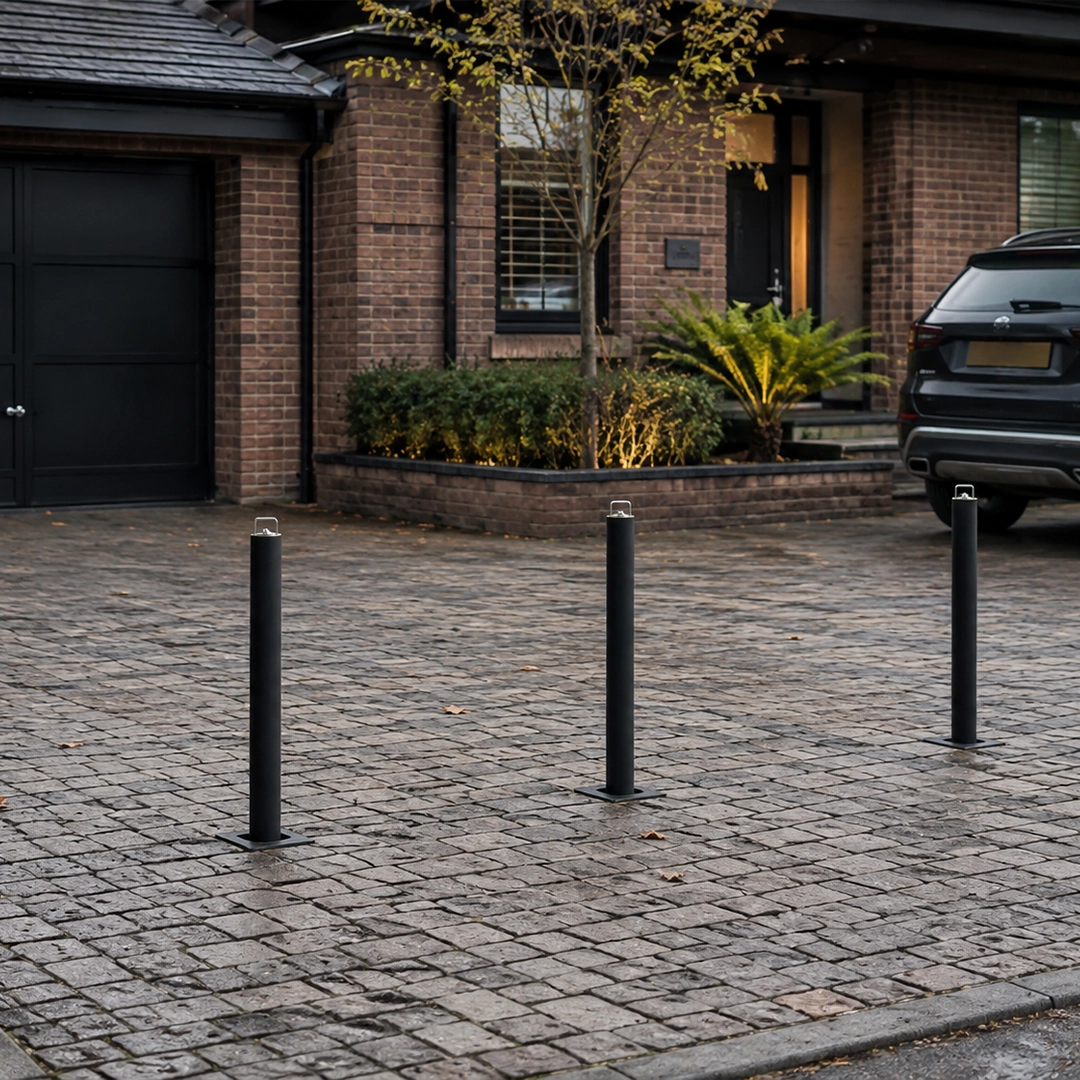
The fundamentals of home security do not change with the seasons, but winter can make some vulnerabilities more noticeable.
Shorter days mean a property may be in darkness before anyone returns home. Exterior lighting that worked well during summer may no longer provide enough visibility, while overgrown shrubs, damaged locks or poorly secured outbuildings can become easier to overlook.
Winter is therefore a useful time to review the property as a whole rather than simply adding another lock or security device.
Start with the main ways somebody could enter the property.
Front doors, back doors, patio doors and accessible windows should close properly and lock securely. If a door does not sit correctly in its frame or a lock has become difficult to operate, it is better to address the underlying problem rather than assuming the lock alone will provide adequate protection.
Remember to include less obvious entrances such as:
A simple habit of checking doors and windows before leaving the property or going to bed can make a meaningful difference.
Exterior lighting can make entrances, paths and driveways easier to see after dark and reduce the number of concealed areas around a property.
Useful places to consider lighting include:
Motion-activated or dusk-to-dawn lighting can provide illumination when it is actually needed rather than leaving powerful lights switched on continuously.
Positioning matters too. A badly placed light can shine into neighbouring properties or create strong shadows that leave other areas difficult to see.
A completely dark property can make it obvious that nobody is home, particularly during the early evening.
Timers or suitable smart lighting can be used to switch selected lamps on and off while the property is empty.
Using more than one room and varying the timing can create a more natural appearance than leaving the same hallway light on continuously.
This can be particularly useful during holidays, evenings out or periods when everybody in the household regularly returns home after dark.
Vehicle keys should not be left prominently beside the front door, on windowsills or within easy reach of a letterbox or cat flap.
Where practical, keep both the main key and any spare key further inside the property.
Owners of keyless vehicles may also choose to use suitable signal-blocking storage when keys are not being used. If you rely on a signal-blocking pouch, it is sensible to check periodically that it is still working as intended.
The same principle applies to keys for security bollards, gates and garages. Keeping all access keys together in an obvious location can undermine several layers of security at once.
Do not make it easy for somebody outside the property to see what is worth taking.
Handbags, wallets, laptops, tablets, vehicle keys and other valuable items should not be left clearly visible through windows.
Vehicles should also be cleared of visible belongings where possible. Even an item that is not particularly valuable can attract unwanted attention if somebody looking into the vehicle does not know what it contains.
Home security should extend beyond the main building.
Garages and sheds commonly contain bicycles, tools, gardening equipment and other valuable items. Tools stored there could also potentially be used elsewhere around the property.
Check that:
Keeping photographs, serial numbers and other identifying information for expensive equipment can also be useful if an item is ever lost or stolen.
A side gate can provide direct access to the back of a home if it is routinely left unlocked.
Where practical, keep gates closed and secured, particularly overnight or when the property is empty.
It is also worth checking the surrounding landscaping. Hedges and shrubs provide privacy, but excessive growth around doors, windows and side passages can reduce visibility from the house or neighbouring properties.
If a vehicle is parked on an open driveway, there may be very little physically separating it from the road.
A properly positioned driveway security bollard can create an additional physical barrier in front of the vehicle and give the homeowner greater control over access to the property.
Unlike cameras or alarms, a bollard physically restricts the route a vehicle would normally take when leaving the driveway.
It should still form part of a wider security setup rather than being relied upon on its own.
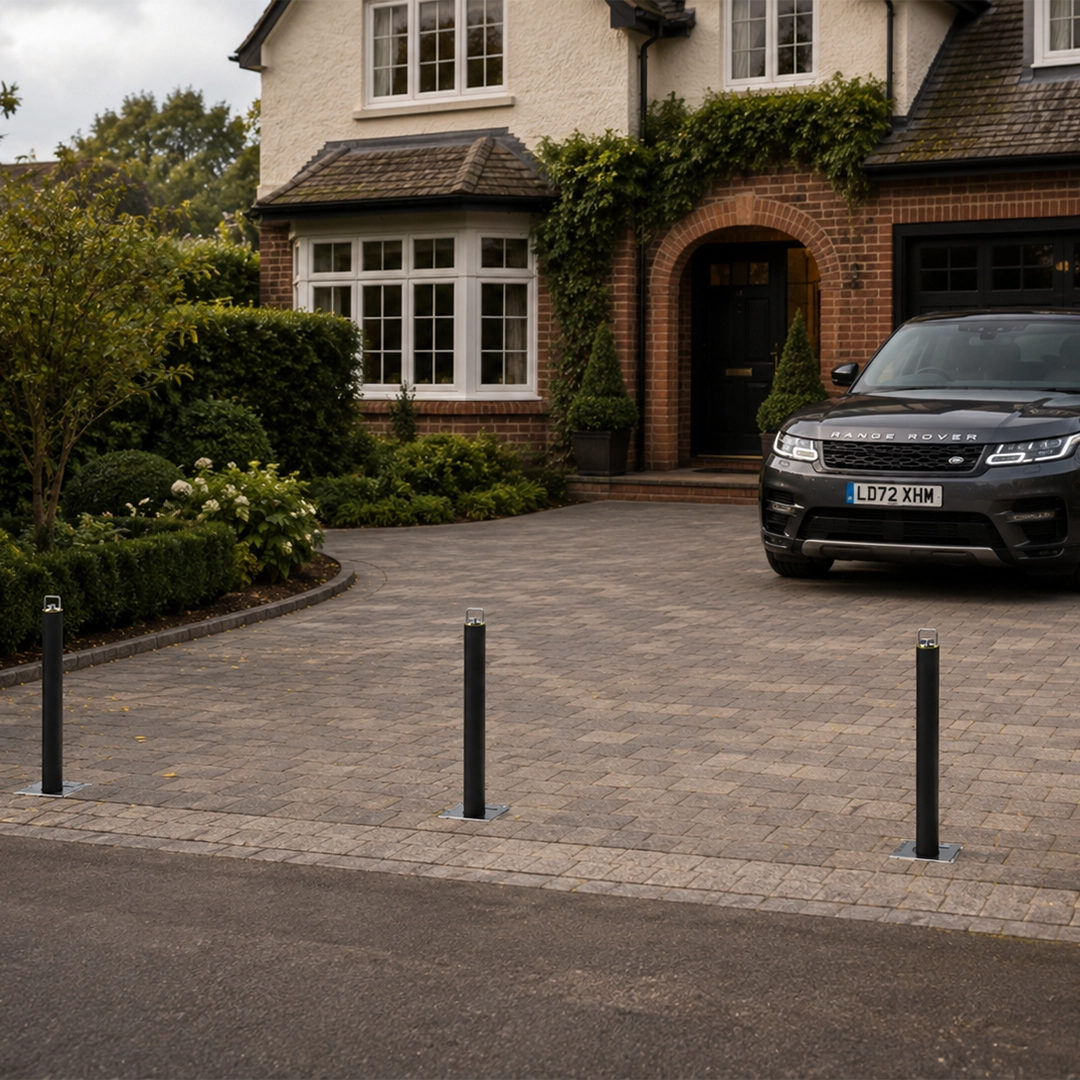
Convenience matters because a driveway bollard can only provide protection when it is raised and secured.
The main manual options include telescopic, removable and fold-down bollards.
Telescopic bollards retract into a housing below the driveway when vehicle access is required.
Once the vehicle is parked, the post can be raised and locked again. Because it remains within its underground housing when lowered, there is no separate bollard to carry away or store.
This can make telescopic security bollards particularly practical for driveways that are opened several times during a normal week.
Removable posts lock into a socket in the ground and are completely lifted out when the driveway needs to be opened.
They leave the entrance clear, although the user needs to be comfortable lifting the bollard and have somewhere suitable to store it.
A fold-down bollard stays attached to the driveway and lowers towards the surface when a vehicle needs to pass.
This can provide a relatively simple access-control solution, although enough space is needed around the lowered post for vehicles and pedestrians to pass safely.
A driveway bollard should complement the security fitted to the vehicle itself.
Before leaving a vehicle overnight:
Physical driveway security and vehicle security perform different jobs. Combining the two creates more than one obstacle that would need to be overcome.
Take a look at your driveway after dark rather than only assessing it during daylight.
Can you see the parked vehicles clearly from the house? Is the driveway entrance completely dark? Are shrubs or walls creating concealed areas immediately beside the vehicle?
Good visibility does not mean flooding the entire front garden with bright lighting. The aim is to avoid obvious blind spots and make activity around the driveway easier to notice.
If you are away during winter, try not to leave obvious signs that the property is empty.
Simple steps can include:
A trusted neighbour, friend or relative may also be able to keep an occasional eye on the property.
Do not leave equipment around the garden that makes access to the property easier.
Ladders should be stored securely rather than left against a wall or unsecured beside a shed. Tools and gardening equipment should also be put away when they are not being used.
This protects the equipment itself and reduces the number of useful items readily available around the property.
Winter weather can affect parts of a property that normally receive little attention.
After particularly poor weather, check whether:
Small maintenance problems are often easier to resolve before they begin affecting how a security feature operates.
Below-ground bollards need a little consideration during wet and cold weather because their moving components sit within the driveway.
Leaves, grit, mud and other debris should not be allowed to build up unnecessarily around the opening.
If a telescopic post becomes unusually difficult to operate, avoid simply forcing it. The cause should be identified so that the mechanism is not damaged.
Proper groundwork and drainage at the installation stage are particularly important for reliable long-term operation.

There is no single product that provides complete driveway security.
A stronger approach combines several different measures, for example:
The benefit of this approach is that the measures perform different functions. Lighting improves visibility, cameras can record activity, vehicle security makes the car itself harder to access or operate, and a bollard physically restricts movement off the driveway.
A quick check at the start of winter is useful, but security should also be reviewed whenever circumstances change.
You might want to reassess the property after:
The security arrangement that worked several years ago may no longer match how the property is being used today.
Home security is important throughout the year, but shorter daylight hours during winter can make lighting, visibility and securing the property before dark more noticeable considerations.
Consider combining physical driveway security with appropriate lighting, vehicle security, secure key storage and CCTV where suitable. A bollard can add a physical obstacle between a parked vehicle and the road.
A raised and locked driveway bollard can make it more difficult to drive a parked vehicle directly onto the road. It should be used alongside the vehicle’s own security measures.
Telescopic bollards are designed for outdoor installation, but proper installation, drainage and routine care are important. Excessive leaves, grit and debris should not be allowed to accumulate around moving components.
Not necessarily. Motion-activated or dusk-to-dawn lighting can provide useful visibility without requiring every exterior light to remain continuously illuminated.
Vehicle keys should be stored securely inside the property and away from obvious or easily accessible positions near doors, windows and letterboxes.
Yes. Garages, sheds and other outbuildings can contain valuable equipment and should form part of the overall security review rather than being treated separately from the house.
Good winter home security is mainly about removing obvious weaknesses and creating several layers of protection around the property.
Check the doors and windows you already have, improve visibility where necessary, keep keys and valuables away from view and make sure garages, sheds and side entrances are properly secured.
If vehicles are parked on an open driveway, adding a physical barrier can provide another useful layer that performs a different job from cameras, alarms and lighting.
If you would like advice on choosing and positioning a security bollard for your driveway, contact Northern Bollards with some details about the property and the proposed installation area.
Tell us what you need and we’ll come back to you with advice, suitable bollard options and the next steps for getting your installation booked.
Read Another Post…