Get In Touch
Tell us what you need and we’ll come back to you with advice, suitable bollard options and the next steps for getting your installation booked.
Commercial security bollards can help businesses control vehicle access, protect parking spaces and create clearer separation between vehicles, pedestrians and vulnerable parts of a site.
They can be used outside offices, shops, warehouses, service yards, car parks and other commercial premises where vehicle movement needs to be managed without permanently closing an entrance.
The right bollard depends on what the business is trying to achieve. A post used to reserve a parking bay has a very different job from a bollard positioned beside a loading area or building entrance. Before choosing a product, it is important to consider vehicle movements, pedestrian access, frequency of use and the level of physical protection required.
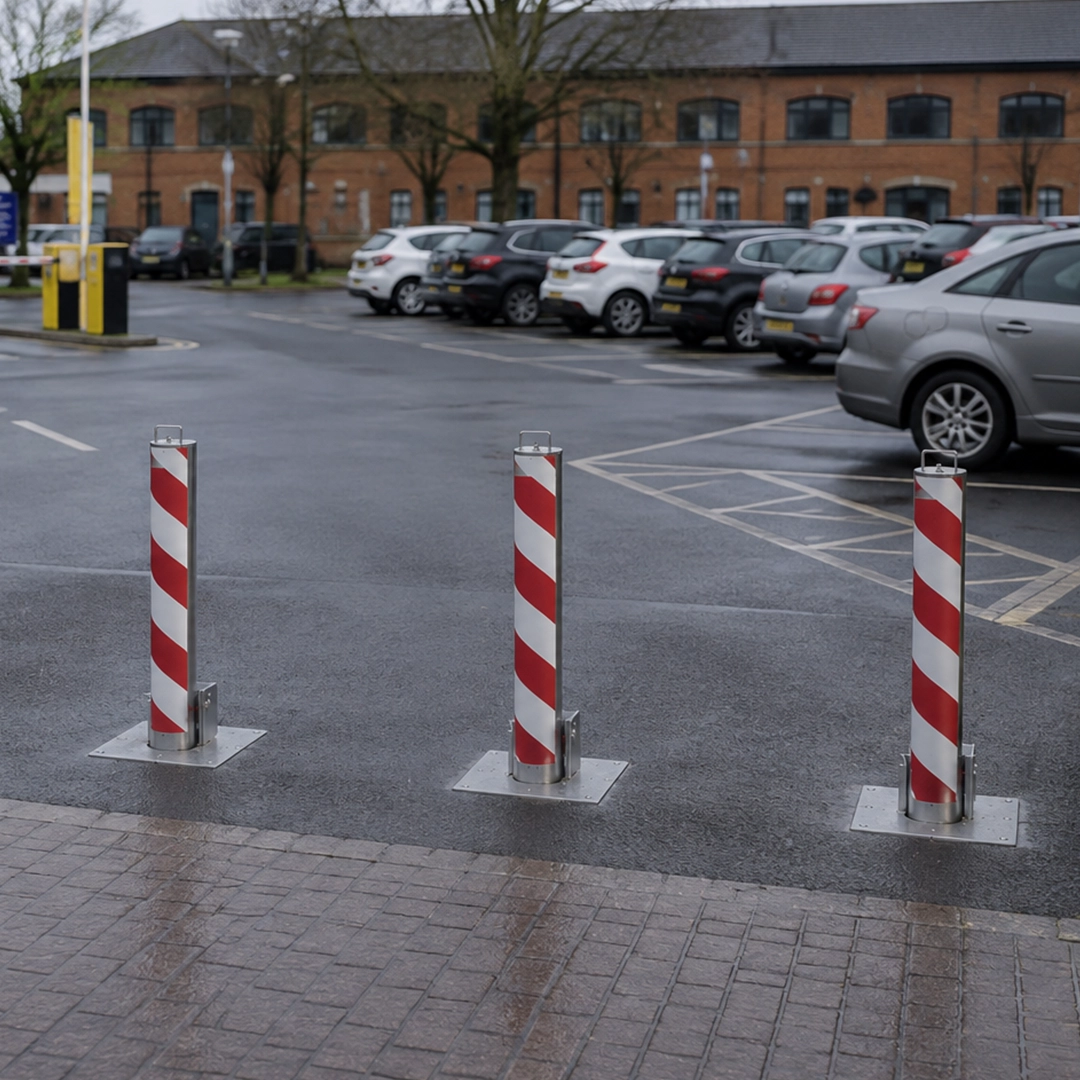
Commercial security bollards are posts used to restrict, control or guide vehicle movement around business premises.
Depending on the application, bollards may be permanently fixed in position or designed to move out of the way when authorised vehicles need access.
Common uses include:
Bollards can form part of a wider site-security arrangement alongside lighting, CCTV, gates, signs and access-control procedures.
The main advantage of a bollard is that it creates a physical restriction rather than relying only on signs or instructions.
A sign may tell a driver not to enter a private area. A raised bollard can physically prevent them from doing so.
Businesses commonly install bollards to solve practical problems such as:
The installation can often be tailored around how the premises operate rather than requiring the whole site to be gated or enclosed.
Bollards can be used in many parts of a commercial property, but their position should follow the way vehicles and people already move around the site.
Businesses with limited parking may need to keep particular bays available for staff, visitors, residents or customers.
A removable, fold-down or retractable bollard can provide a physical way of controlling an individual space while still allowing the authorised user to access it when required.
This can be useful for:
Fixed bollards can help create separation between areas used by vehicles and vulnerable parts of a building.
Potential locations include areas close to:
The purpose of an ordinary commercial bollard in these locations is generally to control routine vehicle movement and define the edge of the traffic area.
A standard parking or access-control bollard should not automatically be assumed to provide tested protection against deliberate or high-speed vehicle impact.
Warehouses and service yards can have several types of traffic moving through the same site, including delivery vehicles, forklifts, staff cars and contractors.
Carefully positioned bollards can help protect:
The position needs to leave enough room for larger vehicles to turn and reverse without introducing a new collision risk.
A business may need to close an access point outside certain hours while still allowing staff, deliveries or service vehicles through during the day.
A manually operated telescopic or removable bollard can provide a straightforward way to open and close the route without installing a permanent barrier across it.
The system needs to be practical for the people using it. If the entrance opens frequently, ease of operation becomes particularly important.
Bollards can also help prevent ordinary cars from entering areas intended for deliveries, waste collection or maintenance vehicles.
This can make vehicle movements more predictable and help keep areas needed for commercial operations clear.
Different bollard designs offer different levels of flexibility. The best option depends on whether access needs to remain permanently closed, regularly opened or only occasionally available.
Fixed bollards remain permanently upright.
They are most suitable where vehicles should never pass through the protected area, such as beside a building, around equipment or along the edge of a pedestrian space.
Because they cannot be moved, their position needs to account for:
Telescopic bollards retract vertically into a housing installed below ground.
When access needs to be restricted, the post can be raised and locked. When an authorised vehicle needs to pass, the bollard lowers into the ground.
This can make them particularly suitable for commercial entrances that are used regularly because there is no separate post to carry away or store.
You can view Northern Bollards’ range of telescopic security bollards for different levels of use and security.
A removable bollard locks into a ground socket and can be lifted out when access is required.
Once removed, the route is completely clear.
This can work well for entrances that only need to be opened occasionally, but businesses need somewhere secure to store the post while it is not in position.
Fold-down bollards remain attached to the ground and pivot towards the surface when access is required.
They can be useful for individual parking spaces or relatively quiet entrances where a straightforward manual system is required.
The lowered bollard remains on the surface, so enough clearance is needed for vehicle tyres, doors and pedestrian movement.
The best choice depends on what needs to be controlled.
If the aim is to reserve individual parking bays, a removable or fold-down post may provide a simple solution.
If the entrance to the whole car park needs to be opened and closed regularly, telescopic bollards may be more convenient because they retract below the surface when access is required.
Permanent fixed bollards may be more appropriate around areas where vehicles should never enter, such as pedestrian spaces, equipment or certain building edges.
A mixed arrangement can therefore be more effective than using the same type of bollard everywhere.
The number required depends on the width of the entrance and the type of vehicles using it.
A narrow access point may only need one suitably positioned bollard. A wider commercial entrance could require several posts to prevent vehicles from simply manoeuvring around the barrier.
When planning the spacing, consider:
The objective is to restrict the vehicle route effectively without making authorised movements unnecessarily difficult.
A commercial installation should be planned around the normal operation of the premises.
Before deciding where bollards will go, it is useful to understand:
Installing posts first and considering traffic movements afterwards can create unnecessary restrictions.
A site used only by cars has different requirements from one regularly accessed by long-wheelbase vans, HGVs or other commercial vehicles.
Large vehicles need more space to turn and may take a different route around a site.
A bollard positioned comfortably away from a car route could be directly within the swept path of a larger delivery vehicle.
This is particularly important around:
Bollards can help separate pedestrians from vehicles, but the layout still needs careful thought.
Posts should not force pedestrians into live traffic areas or create an unnecessary obstruction across an accessible route.
Businesses should consider people using:
Where bollards form part of a wider traffic-management arrangement, signage, road markings, lighting and staff procedures may also be required.
A bollard cannot compensate for a poorly designed vehicle and pedestrian layout on its own.
Visibility can be particularly important in busy car parks, service yards and industrial premises.
A bollard that drivers do not notice can itself become a collision risk.
Depending on the site, visibility may be improved through:
The right appearance will depend on the property. A highly visible finish may be useful within an industrial yard, while a stainless steel or darker bollard may be preferred outside offices or other customer-facing premises.
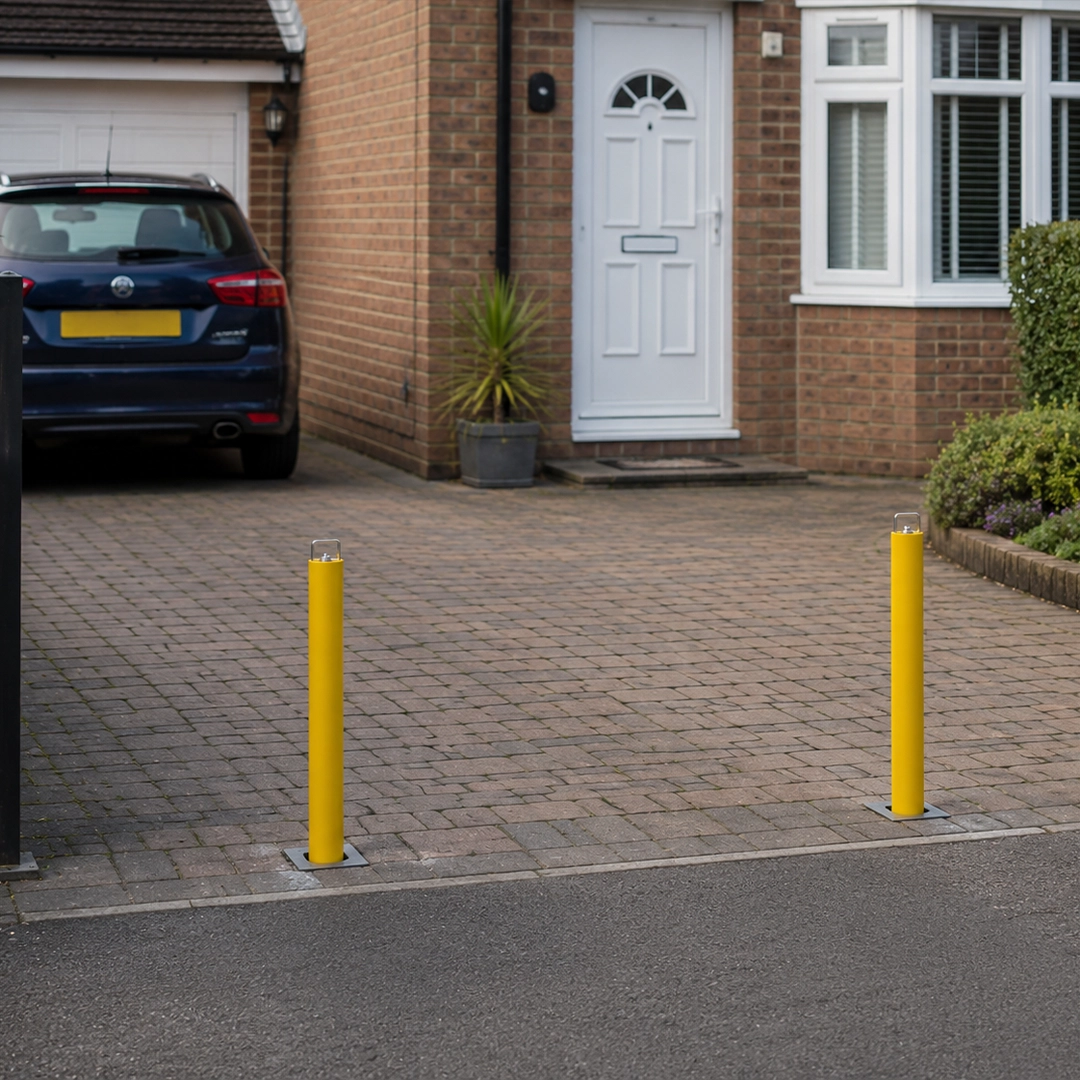
Not every commercial property needs an impact-rated security barrier.
Standard security bollards can be suitable for parking control, ordinary access restriction and separating routine vehicle movements from parts of a property.
Protection against deliberate vehicle attacks is a different requirement.
Where a site faces an identified hostile vehicle risk, the business should seek specialist security advice. Products intended for this purpose are tested against recognised vehicle-impact standards and need to be selected as part of a wider security assessment.
Factors can include:
A normal parking bollard should never be described as crash-rated unless the specific product has the appropriate testing and certification.
Fixed bollards can provide useful separation where low-speed vehicle movement takes place close to a building.
For example, they may help discourage vehicles from travelling too close to:
The level of protection depends on the product, foundation and installation. For ordinary commercial premises, the main purpose may simply be to guide routine vehicle movement rather than resist a major collision.
The installation method depends on both the product and the surface.
Commercial premises may have:
Below-ground bollards require excavation for their housing or ground socket, while fixed products need foundations appropriate to their intended use.
The existing ground condition therefore needs to be considered before installation rather than assuming the same method will work everywhere.

Commercial properties can have a significant amount of infrastructure beneath their car parks, yards and access routes.
Potential services include:
If services pass through the intended installation area, the bollard position may need to be moved.
This is especially relevant for telescopic products because the below-ground housing can require substantial excavation.
A telescopic bollard sits within a housing beneath ground level, so water and debris need to be managed properly around the mechanism.
Poor drainage can allow standing water, mud or grit to collect around moving components.
Suitable installation and routine cleaning can help the bollard continue to operate smoothly over time.
If a manual bollard controls an entrance, the business needs a clear procedure for who can operate it.
Questions to consider include:
Where several manually operated bollards are installed, keyed-alike options can sometimes make management easier by allowing authorised users to operate several posts with the same key.
Yes. Bollards used regularly should be checked periodically so they remain secure and easy to operate.
Routine care may include:
A damaged post should not simply be forced back into operation. Continuing to use a faulty mechanism can make the problem worse or create an avoidable safety risk.
Commercial bollards can control vehicle access, protect parking spaces, define pedestrian areas and help separate vehicles from buildings or equipment.
The best type depends on how frequently the entrance is used. Telescopic bollards can be practical where access regularly needs to be opened, while fixed bollards are better where vehicles should never pass.
Yes. Movable bollards can be used to physically restrict unauthorised vehicles from entering allocated parking spaces.
They can often be installed within tarmac and other common commercial surfaces, subject to the particular product, foundations and conditions beneath the surface.
Manual fixed, removable and telescopic bollards do not generally require mains electricity. They are operated manually rather than using a powered mechanism.
Not automatically. A product should only be described as crash-rated or impact-tested where the specific bollard has evidence of recognised vehicle-impact testing.
Fixed bollards may help create physical separation between normal vehicle movements and a shop front, but the required level of protection should be assessed according to the particular risk.
The number depends on the width of the entrance, the vehicles using it and the spacing needed to prevent unauthorised vehicles passing between or around the posts.
The best commercial bollard installation starts with understanding the site rather than choosing a product first.
Consider what needs to be protected, which vehicles require access, how frequently the entrance is used and how pedestrians move around the property.
From there, the bollard type, number and position can be selected to support normal business activity while providing the required level of access control.
You can browse Northern Bollards’ range of security bollards to explore available options.
For help with commercial parking, access control or security bollard installation, contact Northern Bollards with details of the premises and proposed installation area.
Tell us what you need and we’ll come back to you with advice, suitable bollard options and the next steps for getting your installation booked.
Read Another Post…