Get In Touch
Tell us what you need and we’ll come back to you with advice, suitable bollard options and the next steps for getting your installation booked.
Driveway bollards provide a simple but effective way to improve vehicle security, control access and prevent unwanted parking. When raised and locked, a bollard creates a physical barrier between a parked vehicle and the road, making it harder for somebody to simply drive the vehicle away.
They can also be useful for keeping private driveways and allocated parking spaces clear, controlling access without installing a full gate and adding another layer of security alongside CCTV, alarms and vehicle security devices.
Different designs are available, including telescopic, removable and fold-down bollards, so the right solution will depend on the driveway, the vehicles being protected and how frequently access is required.
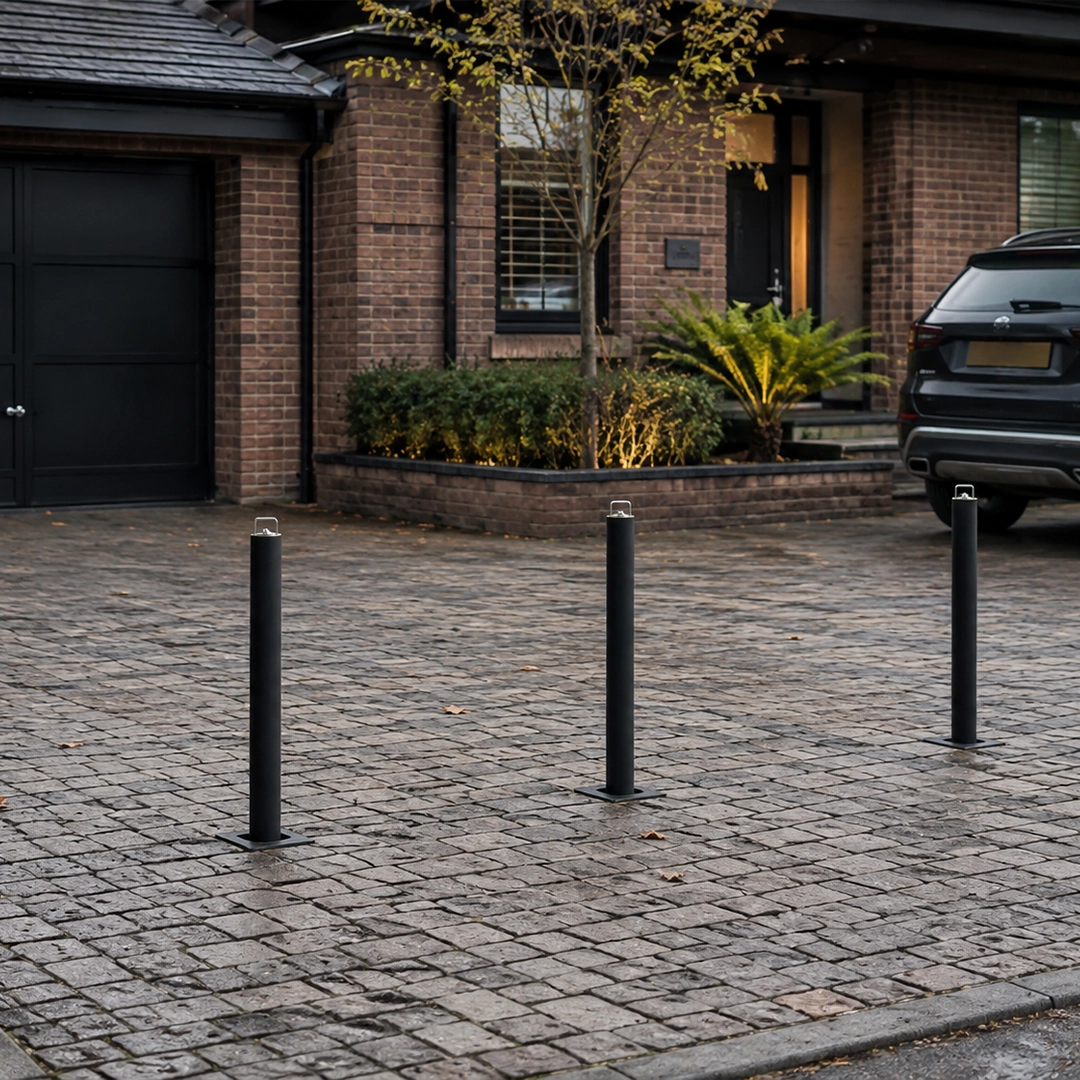
The main advantages of installing driveway bollards include:
No single security measure can remove every risk, but a suitable bollard can make a useful difference when it is correctly positioned and consistently used.
One of the biggest advantages of a driveway bollard is that it physically restricts vehicle movement.
CCTV cameras can record somebody approaching a car. Security lighting can make activity more visible. An alarm may sound if the vehicle is interfered with. None of those measures, however, physically blocks the route between the vehicle and the road.
A raised bollard does.
When positioned correctly in front of a parked vehicle, the bollard creates an additional obstacle that has to be dealt with before the car can be driven off the property.
This can be particularly useful on open-fronted driveways where there is no gate between the parking area and the pavement.
Driveway bollards are often installed as part of a wider approach to vehicle security.
If somebody gains access to a parked vehicle, a locked bollard can prevent them from immediately driving it straight onto the road. That additional barrier can increase the time and effort involved in removing the vehicle.
This does not mean a bollard guarantees that a car cannot be stolen. It is better thought of as another layer of protection.
A sensible vehicle security setup might combine:
Each measure performs a different job. The bollard’s particular advantage is that it creates a physical obstacle rather than simply detecting or recording activity.
Security does not always need to be discreet.
A clearly visible bollard at the entrance to a driveway tells anybody approaching the property that vehicle access is physically controlled.
For an opportunistic offender, seeing that an additional barrier would need to be overcome may make the property less attractive than one where a vehicle has a completely open route onto the road.
Appearance can also be tailored to the setting. Some homeowners prefer black or stainless steel posts that sit relatively discreetly within the driveway, while brighter finishes can be useful where visibility is particularly important.
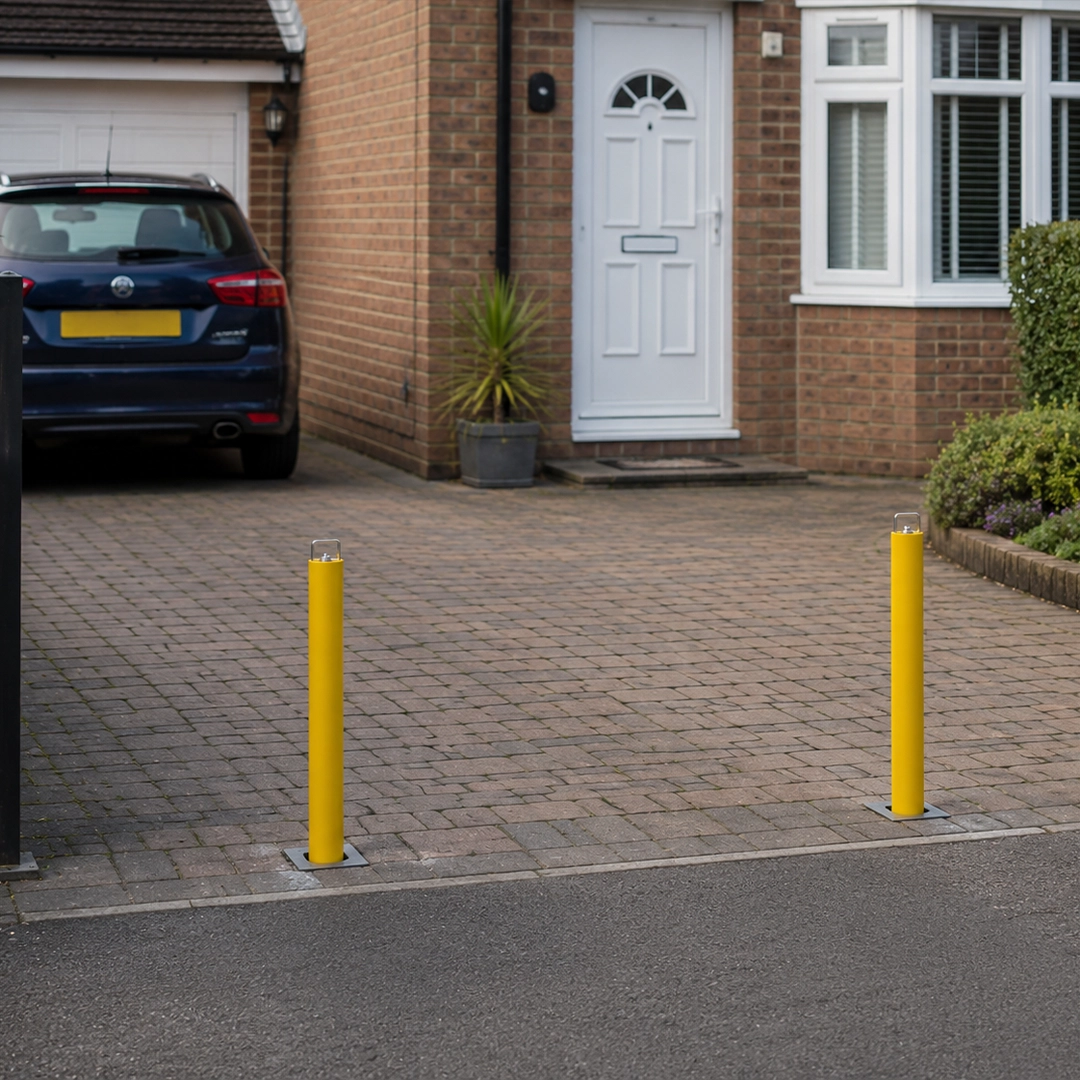
Driveway bollards are not only used to protect vehicles from theft. They can also stop other drivers from using private parking without permission.
When a bollard is raised, a vehicle cannot simply enter the driveway or parking space in the normal way.
This can be particularly useful for homes and private parking spaces close to:
A sign may tell somebody that a space is private. A bollard can physically prevent them from using it.
Not every home has a traditional driveway directly outside the property. Flats, apartments and some newer developments may instead have allocated parking bays within a shared car park.
A suitable parking bollard can help keep an allocated space available for the person entitled to use it.
The bollard can remain raised while the space is empty and then be lowered or removed when the resident returns.
Permission should always be checked before modifying parking within a shared or managed development. Leaseholders may need approval from a freeholder or management company, and the bollard must not interfere with neighbouring spaces, pedestrian routes or emergency access.
A gate is not practical for every driveway.
Some properties do not have suitable walls or posts for gates. Others may have limited space for gates to swing or slide, while the layout near the pavement can make a conventional entrance awkward.
A driveway bollard offers another way to restrict vehicle access without permanently closing the entrance.
When raised, the post blocks vehicles. When lowered or removed, authorised vehicles can enter and leave normally.
This can make bollards suitable for:
Telescopic bollards are particularly useful where a driveway is opened and closed frequently.
Instead of folding across the surface or being carried somewhere else, the bollard lowers vertically into a housing beneath the driveway.
This means there is no loose post to store and very little obstruction remaining above the driveway when access is open.
The post can then be raised again and locked once the vehicle is parked.
This combination of security and everyday practicality is one reason telescopic security bollards are well suited to regularly used residential driveways.
There is no single bollard arrangement that works for every property.
A narrow driveway may only require one post positioned centrally. A wider entrance might need two, three or more bollards to prevent a vehicle from manoeuvring around them.
This flexibility allows the installation to be planned around the individual property.
Important considerations include:
The aim is to create meaningful vehicle control without making normal use of the driveway unnecessarily difficult.

Bollards can also help make the intended vehicle route clearer.
This may be useful on wide, open-fronted properties where there is little visual distinction between the driveway, garden, pedestrian areas and neighbouring land.
Strategically positioned posts can discourage vehicles from cutting across planted areas or entering parts of the property that are not intended for vehicle access.
Fixed bollards may be appropriate where access should remain permanently restricted, while movable bollards are better suited to active driveway entrances.
Depending on their position, bollards can also provide separation between vehicles and vulnerable parts of a property.
For example, a correctly positioned fixed post may help keep low-speed vehicle movements away from:
It is important not to overstate what a standard residential bollard is designed to do. Unless a specific product has undergone recognised impact testing, it should not be assumed to provide protection against high-speed vehicle impact.
Most domestic driveway bollards are primarily designed for access control and vehicle security.
A driveway bollard does not need to replace the security measures already fitted around a home.
It can instead fill a gap that cameras, lights and alarms do not address.
For example:
Using different measures together means an offender may need to overcome several separate obstacles rather than a single security device.
Although manual driveway bollards need to be operated whenever access is opened or closed, the process can become a straightforward part of parking the vehicle.
With a telescopic post, for example, the bollard can be lowered before leaving and raised again once the car is back on the driveway.
The important point is choosing a design that suits everybody who will need to use it.
Consider:
A bollard provides the greatest security benefit when it is convenient enough to be used consistently.
The answer depends on the property and how the driveway is used.
Telescopic bollards lower into the ground when access is required. They are particularly practical where vehicles regularly enter and leave because there is no separate post to remove and store.
Removable bollards lift completely out of a ground socket. They leave the driveway clear once removed but need somewhere suitable to be stored.
Fold-down bollards pivot towards the driveway surface. They remain attached when lowered, which can make them simple to manage where there is enough clearance around the post.
The best design is not necessarily the biggest or most expensive bollard. It is the one that provides appropriate security while remaining practical enough for regular use.
A single bollard can be enough for a narrow driveway if a vehicle cannot pass around either side of it.
Wider driveways may need several posts to close the entrance effectively.
For example, two bollards may be better than one where a wide driveway would otherwise leave a large gap alongside a centrally positioned post.
The correct number depends on the width and layout of the entrance rather than a fixed rule.
No. Although bollards can work well on many properties, the proposed installation still needs to be practical.
Potential issues can include:
These issues do not necessarily mean a bollard cannot be used. They may simply affect the type or position that is most suitable.
Before choosing a product, consider what you actually want the bollards to achieve.
Useful questions include:
Thinking about these points before choosing the product can help avoid ending up with a bollard that is technically secure but impractical for everyday use.
A driveway bollard creates an additional physical barrier between a parked vehicle and the road. It cannot guarantee that theft will never occur, but it can make driving the vehicle away more difficult.
Yes. When raised and locked, a correctly positioned bollard can prevent an unauthorised vehicle from entering a private driveway or allocated parking space.
They can be particularly convenient for residential driveways because the bollard retracts into the ground when access is required rather than needing to be carried away.
One bollard may be enough for a narrow entrance. Wider driveways can require two or more posts to prevent vehicles manoeuvring around the barrier.
Manual driveway bollards do not normally require electricity. They are physically raised, lowered, folded or removed by the user.
In many cases, yes. The paving around the installation area may need to be lifted so the necessary groundwork can be completed and then reinstated afterwards.
They should be kept reasonably clean and operated according to the product instructions. Moving and below-ground components should not be allowed to become excessively clogged with dirt, leaves or debris.
For many homeowners, driveway bollards are a practical investment because they solve several problems with one relatively simple security measure.
They can make vehicle removal more difficult, keep private parking available, control access and provide a visible physical deterrent at the entrance to the property.
The greatest benefit comes from choosing the right bollard for the particular driveway. Strength is important, but so are positioning and ease of use. A bollard that fits naturally into the household’s daily routine is much more likely to be raised and locked whenever protection is needed.
You can view Northern Bollards’ range of driveway security bollards online. If you are unsure how many posts you need or which type would best suit your property, contact Northern Bollards for advice.
Tell us what you need and we’ll come back to you with advice, suitable bollard options and the next steps for getting your installation booked.
Read Another Post…